
The Service Charge Playbook
Service Charges, Governance, and the Limits of Accountability

There comes a point where the same issues appearing in different places stop looking like coincidence. When missing invoices, rising service charges, delayed responses, and legal escalation all begin to mirror each other across landlords, the question shifts. This is no longer about individual failures. It is about whether there is a system at work — one that tenants and residents have been calling out for some time, but which the housing establishment refuses to acknowledge.
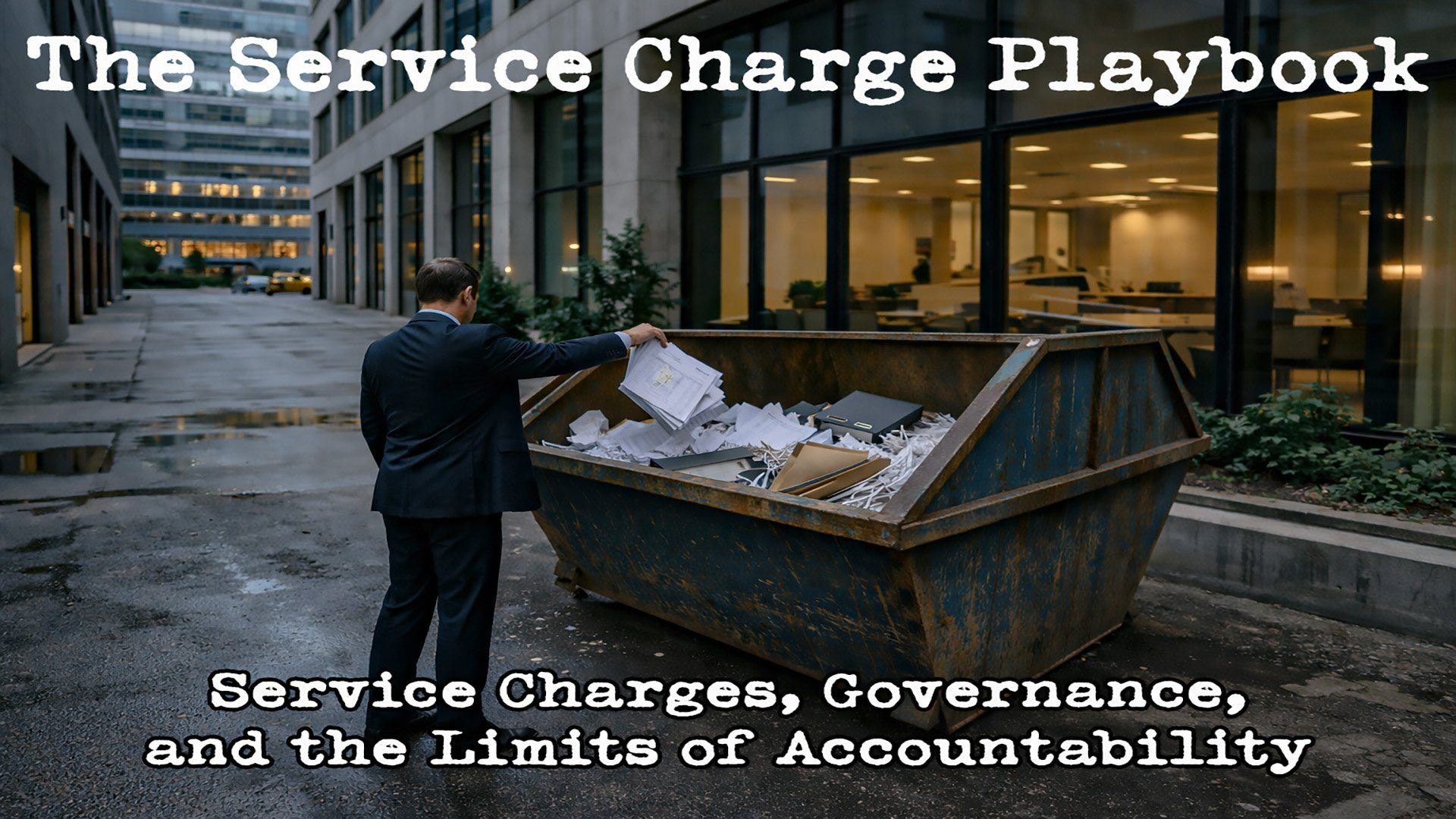
Half the Evidence, All the Charges
In Housing Sector Podcast 68, Missing Invoices, Legal Threats and the Housing Playbook, Suz and I discussed a problem that keeps resurfacing across the sector; residents are being billed, but the evidence behind those bills is either incomplete, delayed, or simply not there. That concern is not theoretical. It is now documented.
A recent investigation by a tenants and residents association found their landlord, focused on Peabody Trust, lays out in stark detail what happens when residents start asking basic questions about service charges. What they found is difficult to ignore.
Between 2021 and 2024, service charges in one Peabody-managed building rose by more than 120%—roughly three times the London average—without any clear explanation provided to residents. When residents eventually received partial disclosure, after waiting years, the numbers did not reconcile. Accounts showed over £1 million in costs, yet the invoices provided totalled closer to £500,000. Half the supporting evidence was missing.
That is not a minor administrative issue. It goes to the heart of whether charges can be considered reasonable at all.
The legal position is straightforward. Leaseholders have the right to request a summary of costs and inspect the underlying invoices. These are not optional extras—they are the mechanism that allows residents to challenge whether charges are justified. In this case, those requests were made. Repeatedly.
They were not fulfilled within the required timeframe, and in some cases, not fulfilled at all. Peabody’s own commissioned review later acknowledged failures to meet its statutory obligations, including late and incomplete disclosure and inaccurate information provided to residents and even external bodies. And yet, despite those admissions, the underlying issues remain unresolved.
More concerningly, the issues did not stop at what residents were being told. The findings indicate that inaccurate information was also shared with external bodies, including the Housing Ombudsman Service. That raises a more serious question about the reliability of the data being relied upon beyond the building itself. If the figures, explanations, or supporting details are later found to be incomplete or incorrect, it is not simply a breakdown in communication—it goes directly to the credibility of the information being used in oversight, scrutiny, and decision-making.
What makes this case significant is not just the scale of the discrepancies, but the paper trail that sits behind it. This is not speculation or assumption. It is based on documented requests, delayed responses, internal reviews, and written acknowledgements of failure. It also reflects something wider.
Because when residents cannot match invoices to charges, when apportionment methods are not explained, and when legal rights to information are not met in practice, the entire system starts to rely on trust rather than evidence. And as discussed in the podcast, once it becomes about trust instead of proof, the balance shifts.
Residents are expected to pay first. And ask questions later.
A Tale of Two Associations
As I continue to interrogate my own service charge figures with GreenSquareAccord, the early signs are already familiar.
GreenSquareAccord were late in responding to a legally required Section 22 request. When they did respond, the information provided did not include the underlying invoices. That matters, because this is not optional. It is evidence that residents are legally entitled to see. Without it, there is no way to properly verify what is being charged.
This is where the concern starts to deepen. Because when the evidence is missing, the burden shifts. Residents are left trying to challenge figures without access to the documents that justify them. And when that challenge is made, the response is often the same: take it further.
In my case, I have now been told to take the matter to the First-tier Tribunal.
GreenSquareAccord, it seems, will not go any further in providing clarity or additional evidence. That is a significant step. It moves what should be a basic request for transparency into a formal legal process. This is something I will be exploring in more detail over the coming weeks and months. But even at this early stage, the parallels with Peabody Trust are difficult to ignore.
This is not just about one landlord failing to provide documents on time. It sits alongside a much wider body of evidence showing repeated service failures, regulatory scrutiny, and harm to residents.
The record for Peabody includes multiple findings of severe maladministration by the Housing Ombudsman Service across 2023 and 2024, covering prolonged disrepair, complaint handling failures, and breakdowns in basic landlord services. These are not isolated incidents. They form a pattern.
That pattern extends beyond repairs. It includes damp and mould cases lasting years, failures to respond to vulnerable residents, and delays running into hundreds of working days—issues serious enough to trigger direct intervention from government, including a formal letter from the then Housing Secretary, Michael Gove, raising concerns about standards falling “significantly below” expectations.
Alongside this sits a long history of mergers and organisational growth. Peabody’s expansion through large-scale integrations has created a complex structure, one that—according to multiple findings—has struggled at times to deliver consistent, reliable services on the ground.
And this is where the connection becomes harder to dismiss. Their history very closely matches that of GreenSquare and later GreenSquareAccord. The same issues, the same concerns, the same reported issues to the Housing Ombudsman, the involvement of the Housing Secretary Michael Gove, the multiple mergers—this is just the very tip of the iceberg.
Both Ian McDermott, Chief Executive of Peabody, and Ruth Cooke, Chief Executive of GreenSquareAccord, sit on the board of the National Housing Federation. This is the same organisation that positions itself as a leading voice for standards, good practice, and the direction of the housing sector. The very same organisation that goes hat in hand to government to ask for loans and grants, with the promise of helping to deliver manifesto commitments of 1.5 million homes. They promise to ensure that, as a country, we will have homes that meet the standards of being warm, safe, dry—and, dare I suggest, affordable. This is the same organisation that lobbies on behalf of the housing sector.
So the question begins to write itself.
If these are the organisations shaping the narrative of what good looks like, why are the same issues—missing evidence, delayed responses, service failures—appearing across multiple landlords? This is no longer just about Peabody, and it has never been just about GreenSquareAccord. It is about whether these are isolated failures or whether they are symptoms of something much wider. In fact, shouldn’t we now be concerned that this is starting to look very much like a playbook?
From Rent Caps to Service Charge Recovery
One of the most revealing structural shifts in the housing sector over the past decade has not been widely advertised, but it is increasingly being felt by residents. When rental income was constrained, revenue didn’t disappear — it moved.
The introduction of rent caps — most notably the 1% annual rent reduction between 2016 and 2020 under the Welfare Reform and Work Act 2016 — significantly reduced projected income for housing associations. According to the National Housing Federation, this policy removed billions from the sector’s long-term financial forecasts. But while rents were regulated, service charges were not subject to the same controls.
That distinction matters.
Unlike rent, which is capped and formula-driven, service charges sit in a more flexible — and, in practice, less scrutinised — space. They are meant to reflect the actual cost of services provided. However, where oversight is weaker and documentation is inconsistent, that flexibility creates opportunity. It is an opportunity that appears to have become too tempting to resist, and with councils and government unable to provide proper oversight, service charges risk becoming the cash cow that keeps housing associations afloat. This also suits government, which cannot afford the financial and political consequences of a housing association collapse.
So what emerges, both in theory and in practice, when you look across multiple cases, is a pattern that begins to resemble a financial workaround. Housing associations still needed to maintain income levels to support development, borrowing, and investor confidence. With rent restricted, attention shifted elsewhere.
The Regulator of Social Housing has repeatedly highlighted the importance of income stability for providers, particularly in maintaining viability ratings and access to finance. At the same time, the development agenda — backed by government and mayoral funding — has continued to push associations to build at scale.
To put that into context, and to keep the focus on Peabody, the Mayor of London, Sadiq Khan, has approved a £50 million loan to Peabody Trust to develop over 500 new affordable homes by March 2032. This funding, announced in March 2026, is drawn from the Homes for Londoners Land Fund, reallocating funds from existing housing schemes to boost affordable housing delivery in the capital.
In practice, service charges became one of the few areas where income could increase without breaching rent controls. This is not always framed as deliberate overcharging. Often, it is presented as cost recovery. But the line between the two becomes blurred when the underlying costs cannot be properly evidenced.
That juxtaposition raises a difficult question — but one we should all be asking. How can an organisation demonstrate financial robustness to secure public funding, while being unable to evidence large portions of costs passed directly to residents? It points to a deeper issue — not just isolated error, but a system where different financial standards appear to apply depending on who is asking the questions.
As Suz Muna of SHAC put it in the podcast discussion, no organisation could present corporate accounts to a regulator with half the supporting documentation missing. It would not be tolerated. Yet in service charge accounting, this appears to happen — and repeatedly.
Corporate accounts are tightly regulated, audited, and scrutinised. Service charge accounts, by comparison, rely heavily on leaseholder challenge. And as many residents know, that challenge requires time, knowledge, persistence, and often legal support. In other words, the system assumes the person being charged will also be the one to police it — as many of us are now discovering.
There is another layer to this that rarely gets discussed. Where residents are in receipt of Housing Benefit or the housing element of Universal Credit, inflated or unsupported service charges are not just paid by the individual — they are underwritten by the taxpayer.
As I have already established from Housing Benefit paid to GreenSquareAccord, Over £83 million has been paid over the last three years, yet none of these figures were meaningfully scrutinised by councils. In many cases, there were no procedures in place to investigate even where suspicion might reasonably arise.
In GreenSquareAccord’s responses to me via Section 22 requests, there is evidence of double charging, charges for services not carried out, and inaccurate calculations — including figures being rounded up where they should have been rounded down. In my case, this has led to a 30% overcharge for me and my neighbours. Extrapolate that percentage across the Housing Benefit paid to GreenSquareAccord over the last three years, and we are no longer talking about small amounts of loose change.
So is the increase in service charges a direct response to rent caps? While it is not the sole driver, it is clearly part of a wider structural shift in how the sector has responded.
The Chartered Institute of Housing delivers training that includes explicit learning outcomes around recovering costs through leases and service charges.
For example, its “Introduction to leasehold management” course states that learners will understand lease terms so they can recover the cost of services, repairs, and major works; understand Section 20 consultation so that the full cost of major works and long-term contracts can be recouped; and apply guidance on recovering service charge debts. That is not wrongdoing in itself, but it is the institutional mechanism through which income recovery via service charges becomes standard managerial practice across organisations.
Second, CIH has co-published, with Savills, analysis that explicitly addresses service charge dynamics in a rent-pressure context. The paper notes the risk of mismatch between service costs and charges, raising the possibility of “re-pooling” and “catch-up” on service charges over time. It also records that up to two-thirds of tenants are supported by Housing Benefit or Universal Credit for rents and eligible service charges, with around three-fifths of income effectively underwritten by benefits.
Elly Hoult who sits on the board of Peabody Trust, while also having served as President of the Chartered Institute of Housing and remaining part of its governing structure. This is not incidental. It is another example of how the same individuals move between landlords, sector bodies, and leadership roles, shaping both the narrative and the standards the sector claims to uphold. When those setting the tone for “best practice” are the same people running organisations facing these issues, it becomes harder to separate oversight from alignment.
So you have rent and cost pressures at provider level, service charge adjustment strategies, and the downstream reality that a substantial share of these costs is mediated through the benefits system — a system we now know is largely unchecked.
What begins as a workaround can quickly become embedded practice. Once service charges are used to stabilise income, rolling them back becomes difficult — particularly when they are tied into long-term contracts, management structures, and expectations around financial performance.
For residents, the result is simple: rising costs, limited transparency, and a system that places the burden of proof on the person being charged.
For the sector, the risk is more fundamental. If service charges are seen not as a reflection of genuine cost, but as a substitute revenue stream, trust breaks down. And once that trust is gone, every charge — justified or not — becomes suspect. Every charge becomes something residents feel they must challenge.
With more housing association CEOs now coming from financial backgrounds, it becomes increasingly clear where the focus sits. Not on resident wellbeing, not on well-maintained homes, and not on long-term community stability — but on financial performance and the expectations of those backing the model.
The Playbook in Plain Sight
At some point, government and the housing establishment will be forced to stop pretending these are isolated incidents. What we are seeing is a pattern. Loopholes are being identified, understood, and then used. Attention shifts away from capped income streams and towards those that are harder to scrutinise. Revenue doesn’t disappear — it is recouped elsewhere. That is not coincidence. That is a playbook.
Across both Peabody and GreenSquareAccord, the same themes appear. Missing or incomplete documentation. Delayed responses to legally required requests. Escalation pushed back onto residents through tribunals. At the same time, both organisations continue to grow, secure funding, and present themselves as stable, well-managed providers.
Sitting above this, the National Housing Federation and the Chartered Institute of Housing position themselves as the standard bearers for good practice, professionalism, and sector leadership. Yet the overlap in leadership — board members, former presidents, and senior figures moving between these organisations — raises a difficult question about independence and accountability.
When those shaping the standards are the same people operating within the system, scrutiny risks becoming alignment.
And when scrutiny becomes alignment, failings become easier to overlook. As long as income is maintained. As long as development targets are met. As long as the numbers stack up on paper. But for residents, and increasingly for taxpayers, the experience is very different.
Rising service charges. Missing evidence. Legal processes used as a barrier rather than a safeguard. And a growing sense that the burden of proof has been quietly reversed. This is no longer about one landlord. It is no longer about one case.
It is about a system that appears to function on the assumption that most people will not have the time, knowledge, or resources to challenge it.
And lest we forget, the National Housing Federation and the Chartered Institute of Housing are not passive observers in all of this. They are funded, in large part, by the very organisations at the centre of these issues — through memberships, conferences, training programmes, and sector events. That funding does not exist in isolation. It ultimately flows from the same income streams, rent and service charges paid by residents. Whether directly or indirectly, money extracted from communities is recycled back into the institutions that promote “best practice” across the sector. That creates an uncomfortable dynamic. Because when influence, income, and oversight sit within the same closed loop, it becomes much harder to argue that these bodies are purely independent voices — rather than integral parts of the system they are meant to challenge.
And that is the real concern, because once you recognise the pattern, it becomes much harder to dismiss it.
Right of Reply
Peabody Trust, GreenSquareAccord, National Housing Federation, and Chartered Institute of Housing were all offered a right of reply in advance of publication.
Peabody provided the following statement, which is included in full:
A spokesperson for Peabody said: “We’d welcome more information about the specific cases referenced, so we can look into them.
As a not-for-profit organisation, we do not make a profit from service charges. Our aim is simply to cover the cost of the services residents receive, and it’s important to us that charges are fair, accurate and easy to understand. We know service charges can be complicated, and we understand how frustrating it is when information isn’t clear or takes too long to come through.
We’re working to improve how we share information and the paperwork behind the charges, and how we respond to questions, so residents can feel confident everything is correct and properly explained. If something hasn’t been handled as it should have been, we will always work to put it right.
We’re committed to being open and listening to residents, so we can keep improving how we do things.”
GreenSquareAccord responded as follows:
“Our approach to the GSA residents’ group has not changed, in that we do not recognise it as an official residents’ group and do not plan to exercise our right to reply on any articles you choose to publish (either through this group or the Housing Sector).”
At the time of publication, no response had been received from the National Housing Federation or the Chartered Institute of Housing.
The responses, and absence of responses, are included here in full for transparency.